


Published by
Teravision - Marketing Team
Share


How AI Is Transforming Software Development Teams in 2026
- AI
06 July 2026
Global IT spending will reach $6.15 trillion in 2026 as engineering organizations race to adopt AI-first workflows. This shift is no longer an experiment. It is structural. Engineering leaders who use manual coding and old project management now see their teams cannot compete with AI-augmented rivals.
Book a discovery call with Teravision Technologies to learn how our AI-ready nearshore teams can help you build and scale your software products 3-5x faster.
AI changes how software teams work in 2026. According to Gartner, 75% of enterprise software engineers will use AI code assistants by 2028, up from under 10% in early 2023. Teams now deploy intelligent agents to handle routine coding, testing, and review tasks while human developers focus on architecture and strategic problem solving. Early adopters report 3-5x faster go-to-market and 30-50% cost savings compared to traditional development approaches.
How does this play out in practice? The data behind the transformation reveals a market that has fully committed to an AI-first future.
Ai Is Transforming Software Development Teams: How Is AI Reshaping Software Development in 2026?
Massive Financial Growth in the Sector
The software world has changed. In 2026, global IT spend will reach more than $6.15 trillion, a 10.8% increase over the previous year according to Gartner. AI-related spend alone will cross $2.53 trillion. This shows AI is now a core part of how teams build software. It is the foundation for every new project, not an experimental add-on.
Summary: AI investment has reached $2.53 trillion in 2026, making AI the default approach for software development rather than an experiment.
How Top Tech Firms Are Leading the Way
The five largest technology firms plan to spend $562 billion on AI infrastructure this year. NVIDIA reported data center sales of $51.2 billion in a single quarter, a 66% year-over-year increase. Private funding reached $300 billion globally in Q1 2026, with approximately 80% going to AI companies. OpenAI now carries a valuation of $500 billion. The market is fully committed to AI. The tools available to engineering teams improve each quarter.
What Is Driving the Current Shift
Why is this change happening so fast? The clearest driver is measurable productivity gain. AI now writes an estimated 29% of Python functions in the United States, according to research published in PubMed (PMID: 41570112). This shifts developers from writing routine code to reviewing and refining AI-generated output. Teams move from planning to shipping faster, and developers spend more time on architecture and design rather than boilerplate tasks.
Summary: Measurable productivity gains, with AI writing 29% of Python functions in the US, are driving rapid adoption across the industry.
Transforming Developer Workflows and Productivity
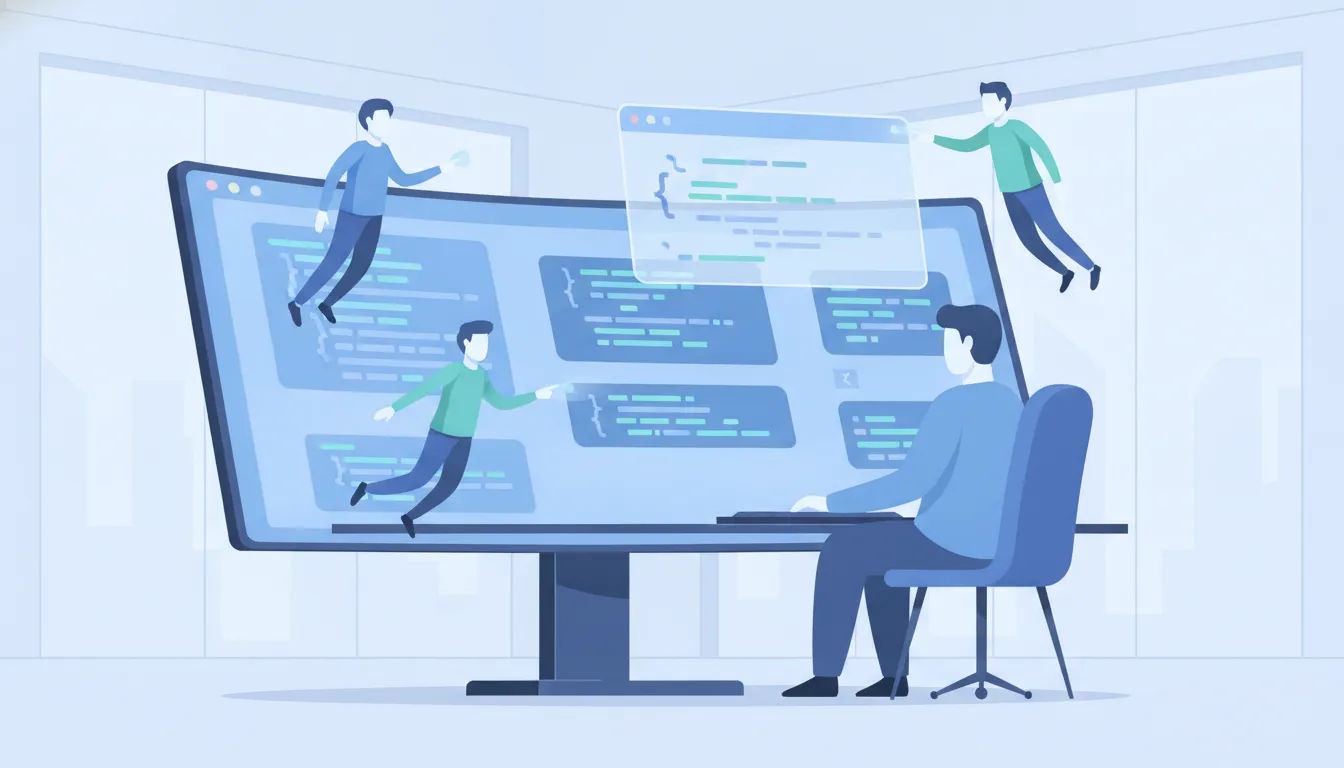
Artificial intelligence has become a standard part of the development environment. Most engineering teams now use AI tools to write, review, and debug their software. By 2028, Gartner expects 75% of enterprise engineers to use AI code assistants. In 2026, the benefits of AI in software development include faster build cycles and measurably higher code quality.
The Rise of AI-Driven Coding
Recent surveys show that 84% of developers now use or plan to use AI tools, with 51% using them daily. Approximately 20 million professionals rely on AI coding assistants. AI helps generate roughly 29% of Python functions in the US market, based on PubMed research. This shift allows teams to handle more work without proportional headcount increases. Senior engineers focus on system design instead of repetitive implementation.
How Daily Work Sessions Have Changed
The way developers work has changed significantly. In early 2025, a typical AI-assisted coding session lasted approximately 4 minutes. By early 2026, that average grew to 23 minutes. This increase reflects growing trust in AI to handle longer, more complex tasks. A single session now involves multiple steps such as reading files, writing code, and running tests. This deeper integration of generative AI in the software development lifecycle enables teams to move much faster than traditional workflows allow.
Summary: AI-assisted coding sessions grew from 4 minutes to 23 minutes in one year, reflecting deeper trust in AI for complex development tasks.
Impact on Speed and Developer Focus
AI tools help teams reduce time spent on routine work. Many teams report a 40% decrease in time spent on boilerplate code. This frees engineering capacity for complex problems that require human judgment. As AI generates more code, human developers spend more time as orchestrators. They review output, ensure alignment with product goals, and handle the architectural decisions that machines cannot make. This workflow is especially effective for nearshore teams that collaborate in real time with their US partners.
Summary: Teams report 40% less time on boilerplate code, freeing engineers to focus on architecture, design, and strategic decisions.
Comparison: Traditional vs AI-Powered Development
| Dimension | Traditional development | AI-powered development |
|---|---|---|
| Team ramp-up time. | 6-10 weeks. | 2 weeks. |
| Code generation. | 100% manual coding. | AI generates 29% of Python functions. Developers review and refine. |
| Developer workflow. | Write every line from scratch. | Orchestrate AI agents. Review and refine AI output. |
| Time on boilerplate code. | 40% of development time. | AI handles 40% reduction in boilerplate time. |
| Go-to-market speed. | Baseline. | 3-5x faster. |
| Cost vs US domestic hiring. | Baseline. | 30-50% savings with nearshore AI-ready teams. |
| Junior developer demand. | High for manual coding tasks. | 40% drop as AI automates entry-level coding. |
What Engineering Roles Are Emerging in the AI Era?
The rise of agentic AI is forcing a structural change in how software teams are organized. Traditional teams built around large groups of junior developers are shrinking. In organizations using AI tools heavily, demand for junior developers has dropped by 40%, according to industry analysis from FirstLine Software. AI now handles many of the smaller tasks that junior developers traditionally performed. Modern teams are becoming leaner and more focused on high-level oversight.
From Writing Code to Orchestrating Systems
Developers are moving away from line-by-line coding toward system design and AI orchestration. Gartner predicts that 75% of engineers will soon spend more time orchestrating and architecting than writing code by hand. Multi-agent systems have seen a 1,445% surge in interest over just over a year. Developers now act as conductors for groups of AI agents that collaborate to solve complex problems. Engineering leaders must focus on building AI-powered software development teams that can manage these automated workflows at scale.
New Specialized Roles in Development
As team structures evolve, new specialized roles are emerging. Companies are hiring AI prompt engineers who refine how teams interact with large language models. AI workflow architects design the paths that automated agents follow through the development process. AI QA specialists verify the growing volume of machine-generated code. These roles require deep understanding of how AI systems think, where they excel, and where they need human oversight.
Summary: New roles including AI prompt engineers, workflow architects, and AI QA specialists are emerging as team structures evolve around AI collaboration.
Hiring priorities now favor people who can use AI to amplify their impact. Rather than raw coding speed, managers seek engineers who understand system-level thinking and can bridge the gap between human intent and machine output. Prompt engineering has become a core competency for every member of a modern engineering team.
Why Nearshore Teams With AI Readiness Deliver Better Outcomes
The advantage is not just in the tools. It is in the teams that know how to use them. A team trained to work alongside AI from day one will consistently outpace a team learning on the job. This is why building AI-powered software development teams has become the single highest-leverage move an engineering leader can make.
The Teravision AI Framework
Every engineer at Teravision is trained as an AI-Ready professional. They use GitHub Copilot, Tabnine, and Amazon CodeWhisperer as standard tools. But tool access alone is not the advantage. The advantage is the proprietary Teravision AI Framework. A structured methodology that governs how engineers integrate AI into every phase of the software development lifecycle from requirements analysis through deployment and monitoring. The framework ensures that AI augmentation is systematic, measurable, and repeatable.
The results are documented. Teravision clients achieve 3-5x faster go-to-market compared to traditional development approaches. Teams ramp in two weeks, not the industry-standard six to ten. With a 95%+ client retention rate across 400+ clients and 1,000+ projects delivered over 20 years, the model has been tested at scale. Flagship clients include McDonald's, Live Nation, UNICEF, Versapay, and MoCaFi.
The Nearshore Advantage, Amplified by AI
AI is transforming software development teams in 2026, and the equation has a geographic dimension that many leaders overlook. Nearshore teams based in Latin America operate in the same time zones (EST and CST) as their US counterparts. This enables real-time collaboration, not overnight handoffs. Cultural alignment with Western business practices and English fluency are standard in the hiring process.
When AI readiness and nearshore proximity come together, the value is clear. Clients typically see 30-50% cost savings versus domestic US hiring without sacrificing speed or quality. Engineering leaders who need to scale quickly can activate a fully AI-trained team through AI-powered dedicated teams or augment existing staff with individual AI-ready engineers through staff augmentation services.
Summary: Nearshore teams with AI readiness combine time-zone alignment, cultural fit, and 30-50% cost savings with the speed of AI-augmented workflows.
Building Your AI-Powered Development Strategy: A Practical Guide
Knowing what is possible is not the same as knowing how to get there. For engineering leaders who want to capture the advantages of AI-transformed development, here is a practical framework.
Assess your team's AI readiness. Start by auditing your current tooling and identifying bottlenecks in your software development lifecycle. Where is your team spending the most time on repetitive work? Common high-impact areas include code generation, testing, code review, and project management. Measure baseline velocity and defect rates before introducing changes so you can quantify improvement later.
Invest in AI training and skill development. Prompt engineering is no longer a niche skill. It is a core competency for every developer. Invest in structured training that teaches your engineers to work effectively with AI coding assistants. Teams that already have AI-Ready training, like those at Teravision, provide an immediate advantage by skipping months of trial and error.
Choose the right AI tools for your stack. GitHub Copilot, Tabnine, and Amazon CodeWhisperer lead the code generation category, but the tooling landscape is broader. Evaluate AI-powered testing platforms, automated code review and security analysis tools, and AI-augmented project management systems. Select tools that integrate with your existing workflow. Refer to the AI engineering team blueprint for guidance on tool selection.
Restructure workflows for AI-human collaboration. The most productive teams in 2026 have moved beyond the developer-writes-everything model. Developers review, refine, and orchestrate AI-generated output. Redefine sprint planning to account for AI-accelerated tasks. Use AI agents for project estimation, dependency analysis, and risk identification. The goal is not to automate the developer out of the process. It is to free them for architecture, design, and strategic decisions.
Partner with AI-ready nearshore teams for faster scaling. Building an AI-ready team from scratch takes months of recruiting, training, and iteration. Partnering with a nearshore provider that already operates on an AI-first model compresses that timeline to weeks. Teravision teams ramp in two weeks, not six to ten, and bring the AI Framework and tooling expertise with them. Combined with AI-powered workflows, this delivers the 3-5x go-to-market acceleration that clients consistently report. For a deeper walkthrough, read the guide on building AI-powered software development teams.
Measure and iterate continuously. The AI-transformed development landscape evolves quarterly, not annually. Track velocity, code quality, review throughput, and deployment frequency. Conduct quarterly evaluations of your AI tooling stack. What worked six months ago may already be obsolete. Teams that see their AI strategy as a living system, not a one-time project, keep their edge over competitors.
Summary: A six-step framework from assessing AI readiness to continuous iteration helps engineering leaders systematically adopt AI-powered development.
Ready to build your AI-powered development team? Book a discovery call with Teravision and get a fully AI-ready nearshore team ramped in just two weeks.
Frequently Asked Questions
How is AI changing software development teams in 2026?
In 2026, AI is a standard part of every software team. Most developers use AI tools daily to write code and identify bugs. These tools handle routine tasks so engineers can focus on architecture and strategy. According to Gartner, approximately 75% of enterprise software engineers will use AI assistants by 2028. This shift helps teams build and ship software faster while maintaining code quality and reliability.
How does AI impact software development roles for junior and senior engineers?
AI is changing how developers work at every level. Senior engineers use AI tools to build complex systems and accelerate their work. Junior developers now focus more on reviewing and testing AI-generated code. Research from PubMed (PMID: 41570112) shows that senior developers derive the most productivity benefit from AI assistance. Team leads spend more time planning how humans and AI agents collaborate to complete projects effectively.
Where does AI deliver the biggest ROI in software development?
AI delivers the greatest return by reducing time spent on routine coding and manual testing. Many teams report a 40% decrease in time spent on boilerplate code, which lets engineers solve more complex business problems. AI tools also identify security issues early, reducing remediation costs later. For companies using AI-ready nearshore teams, the combination of AI efficiency and cost-optimized talent delivers 30-50% savings compared to traditional hiring approaches.
How can a nearshore partner help with AI-driven development?
A nearshore partner like Teravision provides AI-ready engineers who already know how to use the latest development tools. These teams operate in the same time zones as US clients, enabling real-time collaboration. They use structured AI frameworks to help clients complete projects up to 5x faster. Through AI-powered dedicated teams, organizations can scale their engineering capacity in as little as two weeks.
Ready to scale your AI-powered development team?
Technology leaders who wait to adopt AI-powered workflows in 2026 see their development costs rise while their speed to market declines. The competitive gap widens each quarter. Teravision can help you deploy an elite group of AI-ready engineers in under two weeks so your organization does not lose its advantage.
Book a discovery call with Teravision Technologies today and learn how our AI-powered nearshore teams can accelerate your product delivery 3-5x faster than traditional development approaches.
Related Articles



Set up a Discovery Call with us today and start working with Teravision, a company with 20+ years of experience in the software industry and Development Centers in Mexico and Colombia



Dedicated Software Teams
Augmented Teams
What's the Difference